01
Assessing Cataract Severity
Examination of the natural lens to determine the degree of opacity and its effect on vision, glare, and daily activities.
Detailed cataract assessment using advanced diagnostic technology, with discussion of available options and selection of the most appropriate intraocular lens according to each patient’s measurements and daily visual needs.
The choice of surgery and lens is not the same for everyone; it depends on detailed testing, lifestyle, and individual visual needs.
Examination of the natural lens to determine the degree of opacity and its effect on vision, glare, and daily activities.
Assessment of corneal shape, thickness, and regularity to support accurate measurements and treatment planning.
Confirming retinal and optic nerve health and identifying factors that may affect the expected postoperative result.
Precise measurement of axial length and corneal curvature to calculate the appropriate intraocular lens power.
Discussion of monofocal, enhanced monofocal, extended-depth-of-focus, and multifocal lenses according to ocular suitability.
Considering work, driving, reading, device use, and the desire to reduce dependence on glasses.
Removal of the cataract and implantation of the selected lens using modern surgical techniques and an individualized plan.
Monitoring recovery, eye pressure, wound healing, and visual improvement, with clear instructions and an eye-drop schedule.
Explaining the expected result and limitations of each lens type before the final decision.
The benefit of each lens depends on the range for which it is designed to provide the best clarity, and glasses may still be needed for some distances after surgery.
For activities requiring clear vision of distant objects.
For daily tasks between reading distance and far vision.
For detailed tasks performed close to the eyes.
The following table is for general guidance. Final lens selection depends on corneal, retinal, and optic nerve health, ocular measurements, and your everyday visual needs.
| Lens Type | Distance Vision | Intermediate Vision | Near Vision | Expected Dependence on Glasses | Simple Notes |
|---|---|---|---|---|---|
| Monofocal | Usually excellent when targeted for distance | Limited | Limited | Glasses are often needed for computer work and reading | Good clarity and optical simplicity; suitable for many patients. |
| Enhanced Monofocal (Monofocal Plus) |
Usually excellent | Better than traditional monofocal | Limited | May reduce the need for intermediate glasses, while reading glasses are still often required | Provides a modest extension of vision while retaining characteristics similar to a monofocal lens. |
| Extended Depth of Focus (EDOF) |
Very good to excellent | Usually very good | Moderate and may not be sufficient for small print | Glasses may be needed for some fine reading tasks | A useful option for patients prioritizing distance and computer vision while reducing dependence on glasses. |
| Trifocal | Very good | Very good | Usually good | Less dependence on glasses across most distances | Some patients may experience glare or halos at night; careful patient selection is important. |
Results vary between patients, and no single lens is ideal for every eye or every visual need.
In some cases, replacing the cloudy lens alone is not enough because corneal astigmatism can affect postoperative visual clarity. Toric intraocular lenses are available to correct astigmatism during cataract surgery after detailed measurements of each eye.
Lens power and axis are selected from corneal measurements and astigmatism magnitude to improve visual quality and reduce dependence on distance glasses as much as possible.
We discuss the degree of astigmatism, corneal condition, visual needs, and lifestyle before recommending a lens. The goal is not to sell a particular lens, but to select the lens that gives your eye the best opportunity for stable, clear vision.
Book an Intraocular Lens Assessment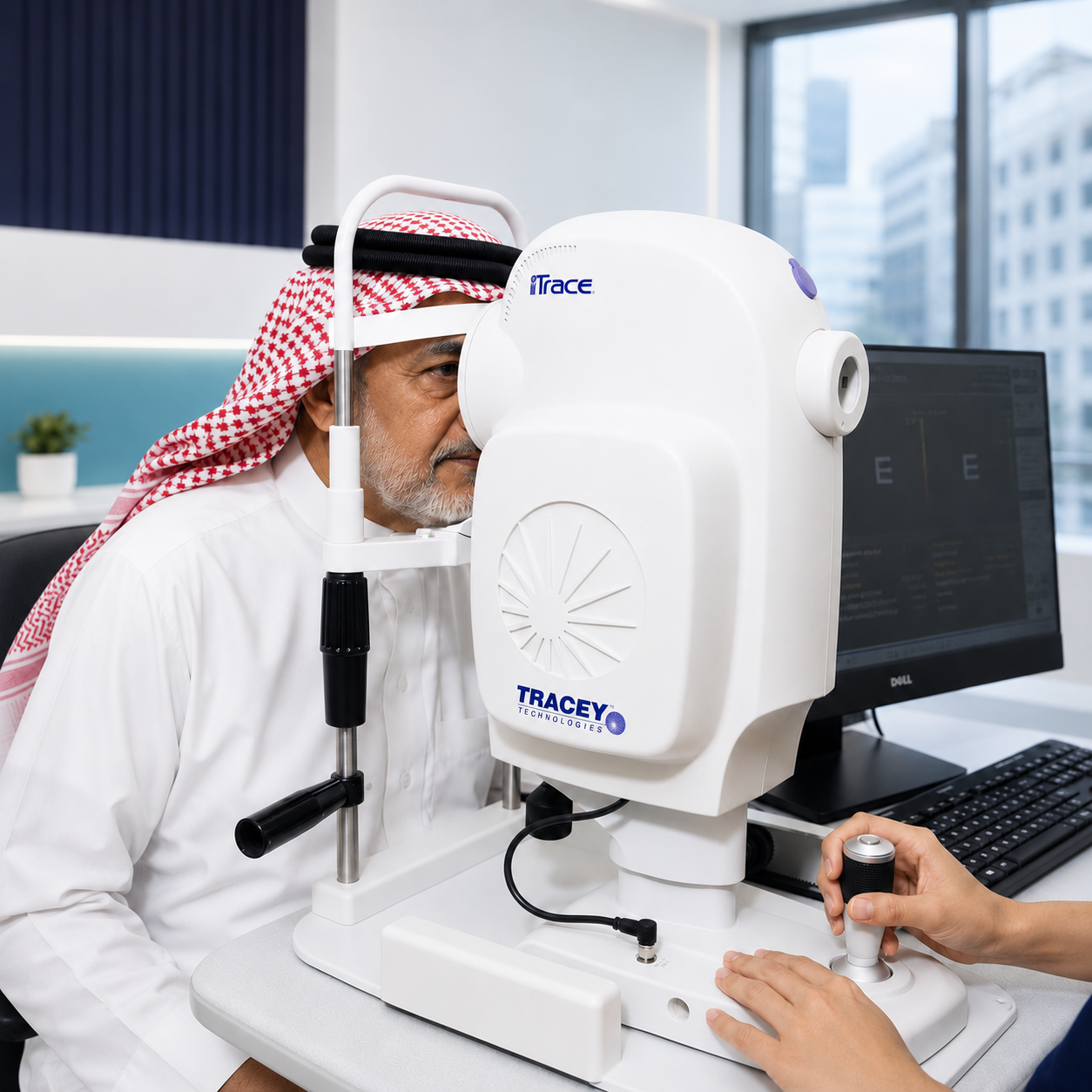
The device combines optical aberration analysis with corneal mapping to help identify the source of reduced visual quality and assess suitability for selected advanced lenses.
The decision for surgery is based on how reduced vision affects daily life, not only on the cataract grade seen during examination.
Especially when daily activities become difficult to perform comfortably.
Such as difficulty driving or discomfort from headlights and other lights.
When images appear less clear or colors seem less vivid.
When updating the prescription no longer provides sufficient improvement.
When reduced vision interferes with reading, device use, or work tasks.
Book an appointment for cataract assessment and discussion of lens options and the most appropriate plan for each eye.